
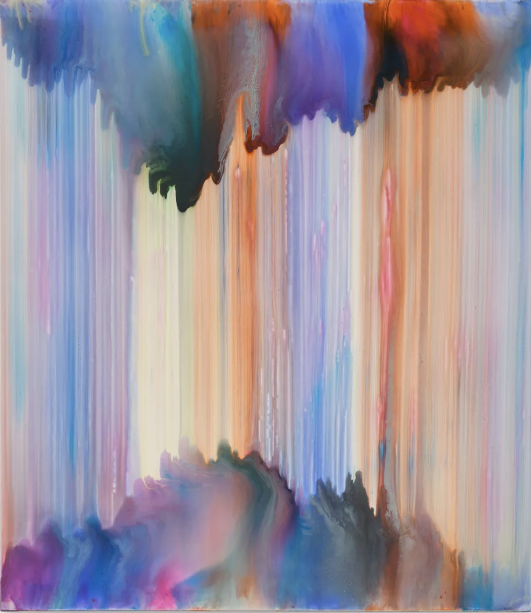

In Voni, Bernard Frize transforms abstraction into a study of process, flow, and controlled unpredictability. Cascading verticalbands of diluted color descend across the canvas in translucent layers of violet, blue, orange, pink, and black, creating a surfacethat feels mechanical and atmospheric. Rather than emphasizing expressive gesture in the traditional Abstract Expressionistsense, Frize allows gravity, viscosity, timing, and material behavior to partially determine the image itself. The painting appearsfluid and effortless, yet its structure is rigorously controlled beneath the surface.
Frize occupies a unique position within contemporary abstraction because his work both inherits and dismantles the legacy ofpostwar painting. Where Pollock and de Kooning mythologized the artist’s hand as a site of existential drama, Frize intentionallyreduces personal gesture, treating painting instead as a system, experiment, and event. Yet despite this conceptual distance, thework remains intensely sensual and emotionally immersive through color alone.
Voni represents the evolution of abstraction after the collapse of heroic modernism. The emotional charge of AbstractExpressionism survives here not through aggression or mythology, but through process, atmosphere, and the quiet instability ofmaterial itself.

