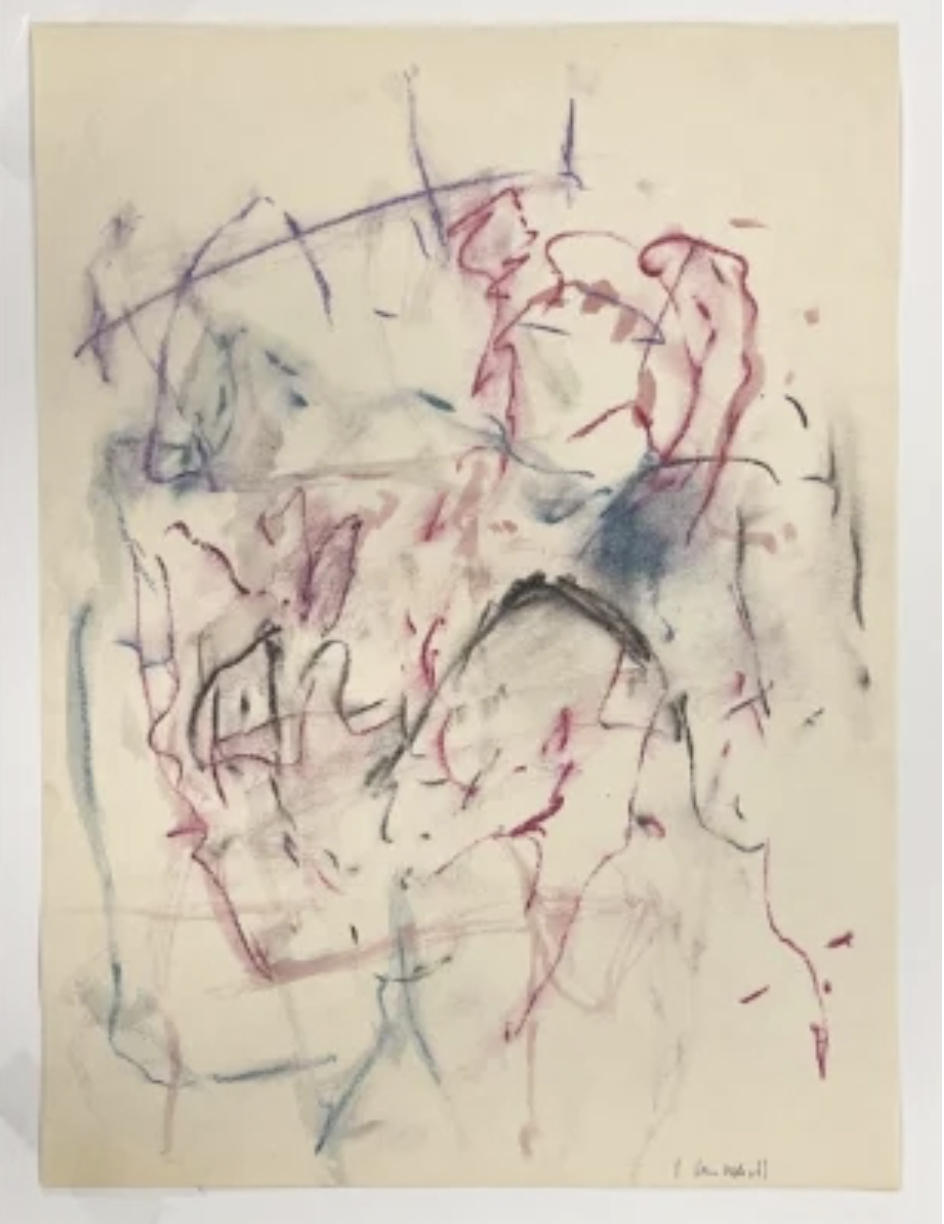

This intimate work on paper reveals Joan Mitchell’s extraordinary ability to turn gesture into emotion, memory, and atmosphere simultaneously. Loose violet, pink, blue, and black lines collide and dissolve across the surface with a nervous lyricism that feels both spontaneous and deeply controlled. Unlike the monumental scale often associated with Abstract Expressionism, this drawing-like composition exposes the immediacy of Mitchell’s hand—where mark-making becomes thought in motion.
Mitchell belonged to the second wave of the New York School, yet her work resisted the heroic masculinity that dominated postwar abstraction. Rather than treating painting as conquest or existential struggle, she approached it as sensation: a way to translate landscape, weather, recollection, and psychological intensity into physical form. Even in smaller works such as this, her compositions feel expansive, almost atmospheric, as though fragments of nature and memory are continuously surfacing and disappearing.
The work represents a crucial evolution within Abstract Expressionism—where gesture becomes less aggressive and more lyrical, yet no less emotionally charged. Mitchell transformed abstraction into something simultaneously intimate, unstable, and profoundly human.
Mitchell spent meaningful time in the Hamptons and East Hampton art community during the 1950s and early 1960s.

Thank you! Your submission has been received!
Oops! Something went wrong while submitting the form.
.avif)

