
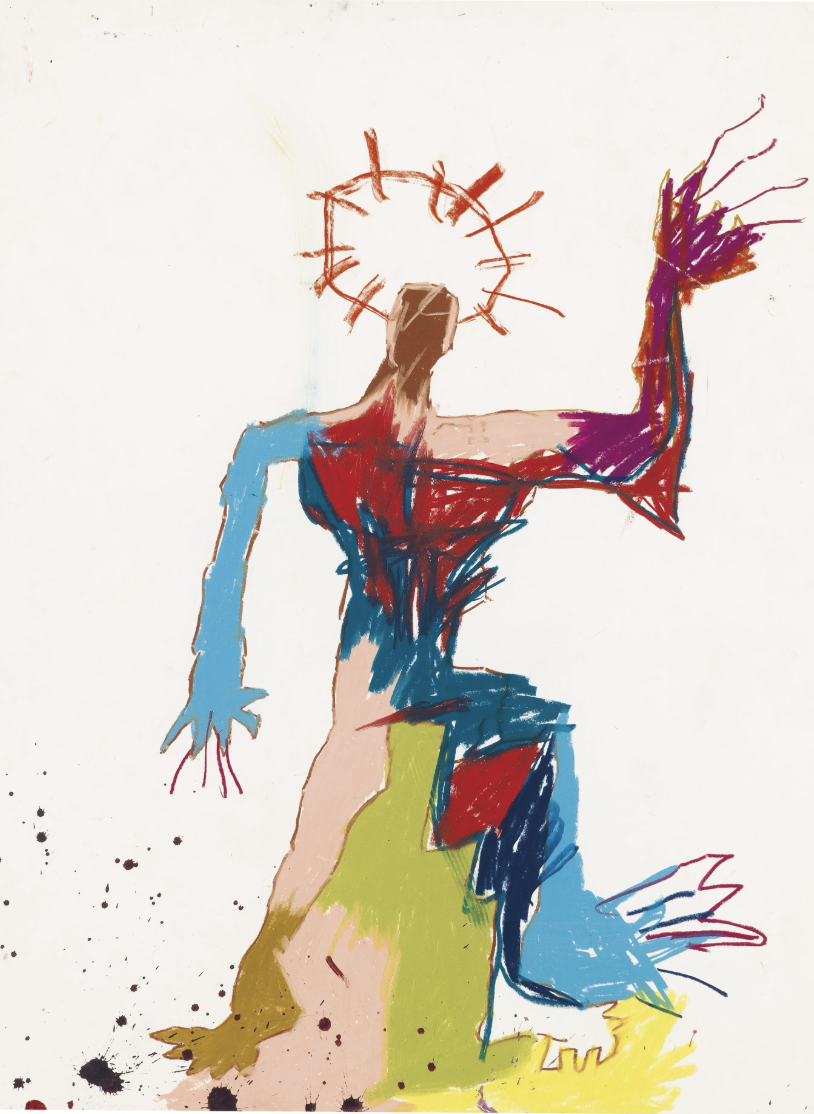

Created at the height of his meteoric rise, this 1982 work captures Jean-Michel Basquiat at the moment he transforms rawgesture into a new visual language. The fractured figure—part anatomy, part symbol—embodies a tension between control andrupture, where mark-making becomes both narrative and resistance. Basquiat collapses figuration into urgency, rejecting classicalstructure while still insisting on the body as a site of meaning. In this work Basquiat’s figure in motion appears to be reaching, forsomething...
His popular cultural bandwidth extends far beyond painting, into: music, fashion, and contemporary image culture, makinghis work a permanent part of global visual consciousness. Major works from 1982 are widely considered apex Basquiat: rare,historically pivotal, and central to the evolution of contemporary art.
Emerging from downtown New York’s post-punk and graffiti scenes, his work helped redefine painting in the 1980s, bridgingstreet culture and the blue-chip art world. Where The Lost Generation reflects disorientation, Basquiat channels chaos into a newsyntax; one that feels immediate, coded, and alive.
In the 80’s, Basquiat spent time in the Hamptons and in Montauk with Andy Warhol at his estate, known as Eothen (Greek for“at first light”), on Cliff Drive.

