
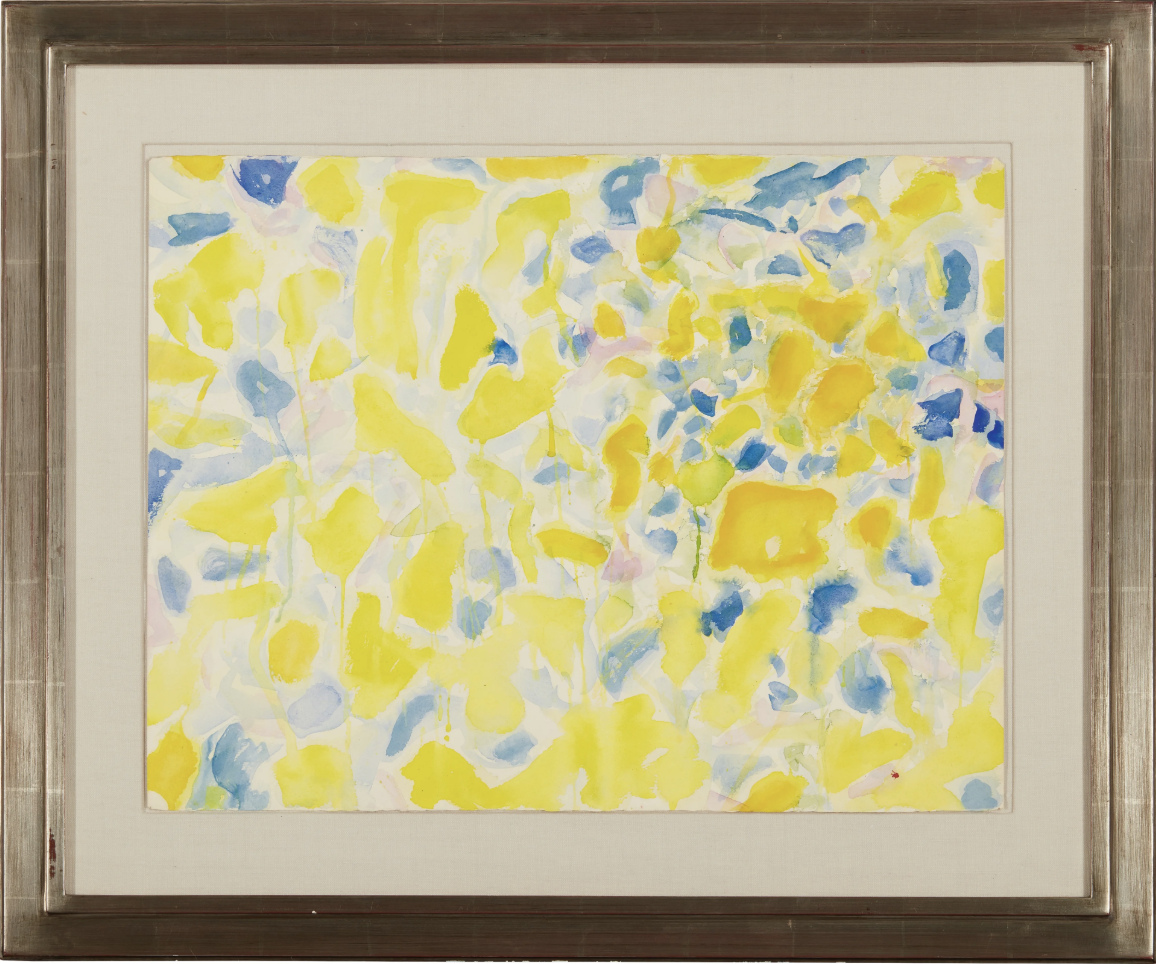

Painted in 1952, To Hölderlin captures Sam Francis at the beginning of the breakthrough period that would make him one ofthe most internationally influential American painters of the postwar era. Unlike the dense existential surfaces associated withearly New York School painting, Francis approached abstraction through light, atmosphere, and expansion. Here, luminousyellows and floating blues dissolve across the paper like shifting air, turning watercolor into something almost musical and spatialrather than fixed or structural.
The title’s reference to the German Romantic poet Friedrich Hölderlin is significant. Francis often connected painting to poetry,transcendence, and psychological states, pushing Abstract Expressionism beyond aggression and into something more lyricaland cosmopolitan. Having spent formative years in Paris and later Japan, Francis expanded the movement into a more globallanguage of openness, color, and perception.
The work holds a sense of optimism, although it was created only a few years after Pollock’s black paintings and de Kooning’sfractured figures, To Hölderlin suggests another direction for postwar abstraction—less burdened by conflict, and more investedin light, movement, and the possibility of spiritual release.
Francis spent time in the East Hampton social and artistic orbit during the 1950s–60s.

