
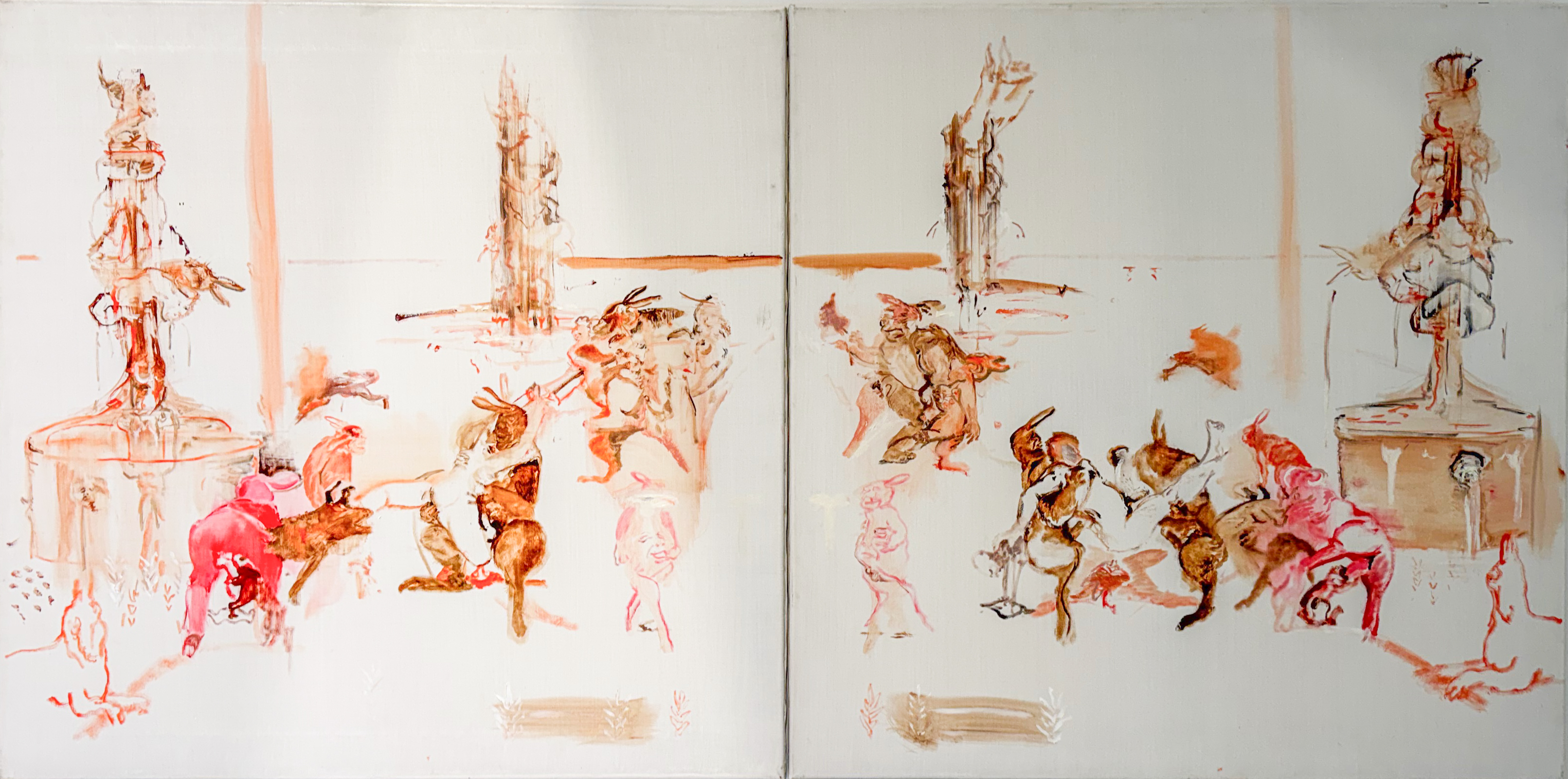

With Lust and Aggression I, Cecily Brown reopens the central tension that defined Willem de Kooning and the AbstractExpressionists decades earlier: the collision between abstraction and the body. Painted in 1996, the work channels the physicalvelocity and sensual fragmentation of de Kooning’s Woman paintings, but filters them through the media-saturated,psychologically charged culture of the late twentieth century. Figures emerge and dissolve within sweeping gestures, eroticsuggestion, and painterly excess, never fully stabilizing into narrative or form.
Brown belongs to a generation of painters who revived gestural painting after Minimalism and Conceptual Art had seeminglyexhausted it. What makes this work especially meaningful is the way it transforms the masculine aggression historically associatedwith Abstract Expressionism into something more unstable, theatrical, and psychologically layered. Desire, violence, humor, andvulnerability circulate simultaneously across the surface.
Lust and Aggression I functions as both continuation and critique of the AbEx legacy. Brown does not simply imitate deKooning—she destabilizes him from within, carrying postwar gestural painting into a contemporary era shaped by genderpolitics, media imagery, and fractured identity.
Brown has spent time on the East End and belongs to the later generation of painters drawn to the Hamptons after the originalNew York School era.
.avif)

