
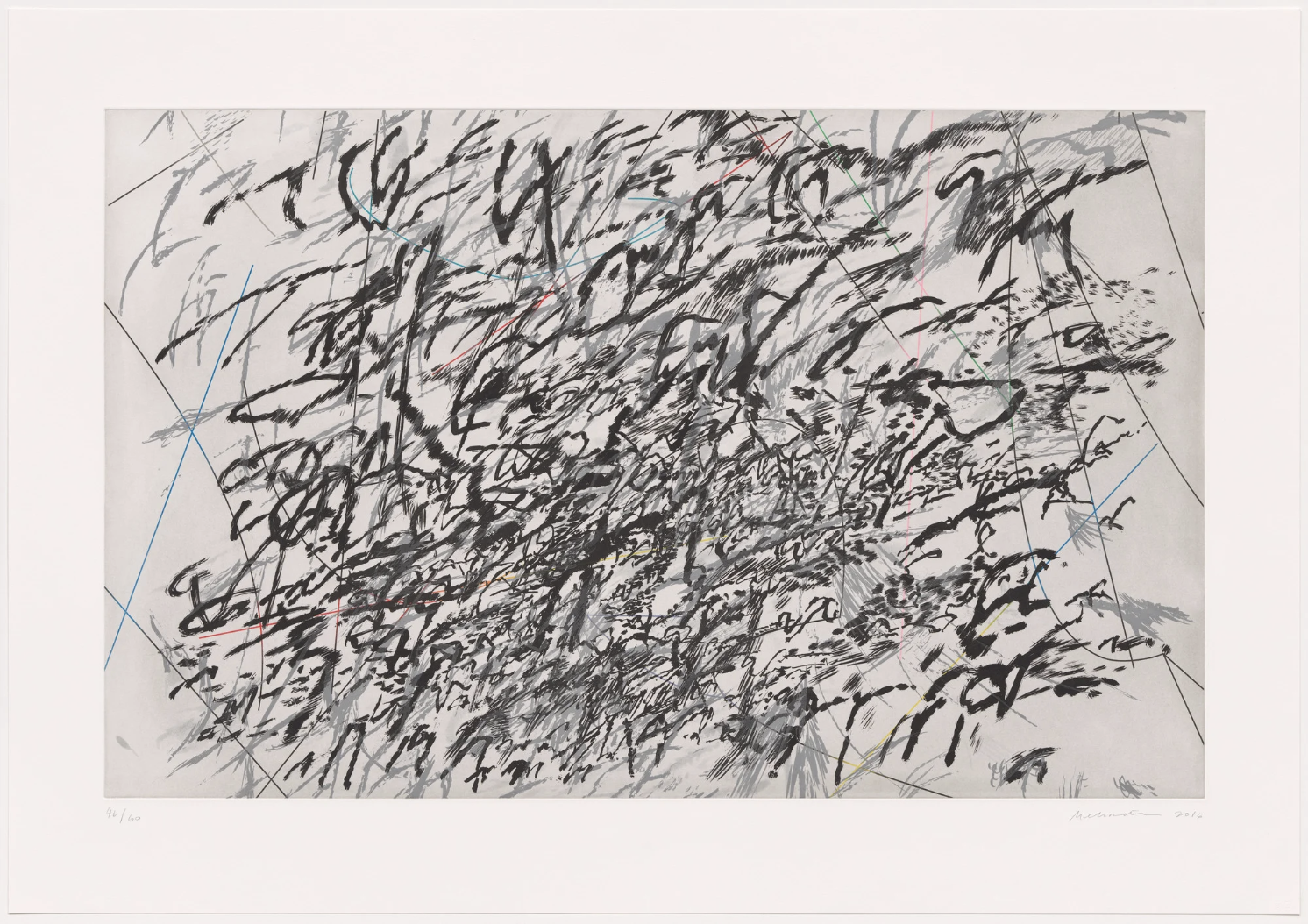

In Epoch, Julie Mehretu extends the visual language of Abstract Expressionism into the fractured speed and instability of thetwenty-first century. Dense black gestures collide across the surface like erased architecture, weather systems, cartographicfragments, or compressed histories in motion. Beneath the turbulence, faint lines and flashes of color emerge and disappear,creating a composition that feels simultaneously constructed and collapsing.
What makes Mehretu important within The Lost Generation is the direct bridge her work forms back to the New York School.The nervous energy of Pollock, the structural fragmentation of de Kooning, and the all-over spatial intensity of Joan Mitchellremain embedded in her visual language. But where Abstract Expressionism translated postwar existential anxiety into gesture,Mehretu redirects that energy toward globalization, migration, surveillance, urban density, and information overload. Gesture nolonger represents the isolated psyche; it becomes the mapping of contemporary systems and collective instability.
In this way, Epoch functions as a contemporary evolution of AbEx rather than a rejection of it. The heroic gesture survives, buttransformed by the realities of a networked and accelerated world.

