
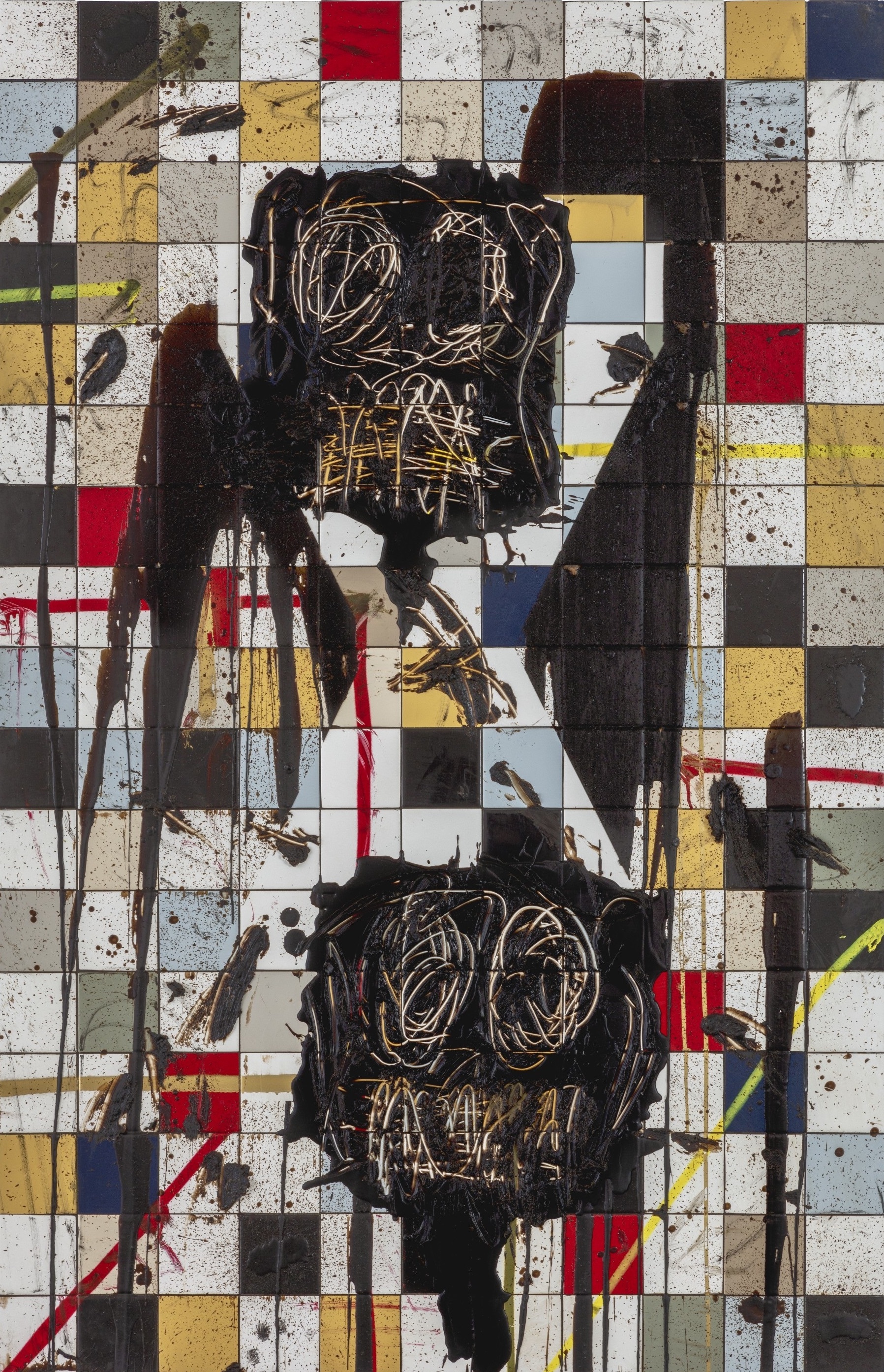

With Color Men, Rashid Johnson transforms the gestural language of Abstract Expressionism into a contemporary meditationon identity, anxiety, race, and psychological fragmentation. Built from gridded ceramic tiles layered with black soap, spray enamel,wax, and aggressively drawn faces, the work merges painting, installation, graffiti, and symbolic portraiture into a surface that feelssimultaneously controlled and unstable. The repeated heads appear mask-like, cartoonish, and haunted at once—part self-image,part cultural code, part emotional residue.
Johnson’s significance within contemporary art lies in his ability to absorb the visual authority of postwar abstraction whileconfronting the social realities that movement often avoided. The drips, gestures, and material force recall Pollock, de Kooning,and Kline, yet Johnson redirects that language toward questions of Black subjectivity and contemporary psychic life. Even thetiled grid subtly echoes modernist structure while threatening to collapse beneath emotional pressure.
In The Lost Generation, Color Men functions as a bridge between the existential anxiety of the New York School and thefractured cultural identity of the present moment. Johnson inherits the physical energy of AbEx, but replaces its mythology ofheroic universality with something more vulnerable, coded, and socially charged.
Johnson is a contemporary continuation of gestural abstraction within New York/East Coast art culture.

