
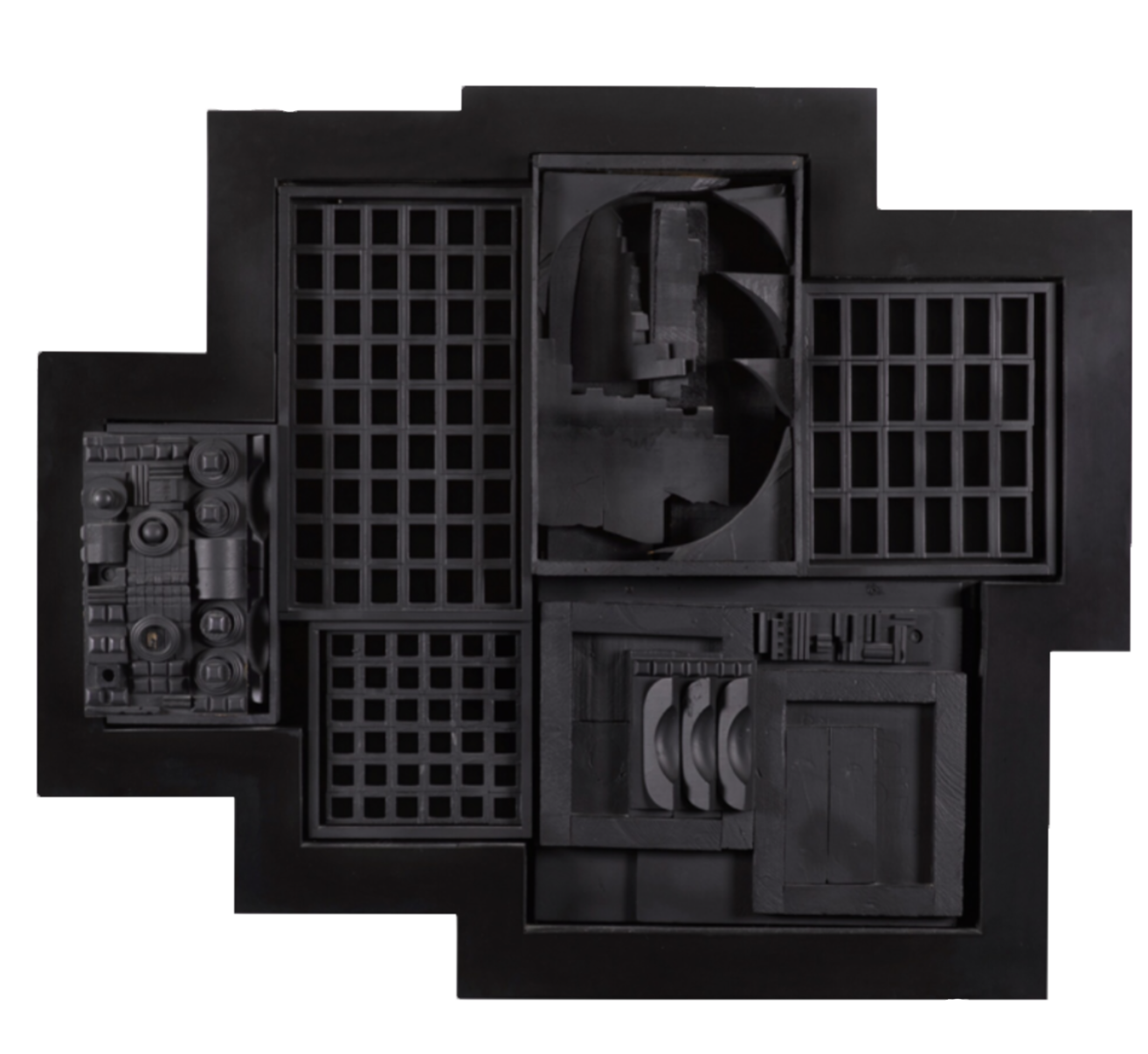

By 1968, Louise Nevelson had transformed sculpture into architecture, shadow, and psychological space. In Black Zag S,compartments, grids, curves, and found wooden elements are compressed into a monumental black structure that feelssimultaneously urban and cosmic. Unlike traditional sculpture, which occupies space through mass, Nevelson’s constructionsactivate absence, rhythm, and void. Painted entirely black, the assemblage absorbs individual objects into a single unifiedenvironment, where shape and shadow become inseparable.
Nevelson occupies a singular position within the postwar canon. Closely associated with Abstract Expressionism yet workingsculpturally rather than pictorially, she expanded the movement’s emotional and spatial ambitions beyond the canvas. Her use ofdiscarded architectural fragments transformed debris into something ritualistic and monumental, anticipating later installationart and Minimalist structure while retaining the emotional intensity of the New York School.
With tension between order and instability, the work resembles a fractured cityscape, machine, altar, or coded language allat once. It reflects the moment when postwar abstraction expanded into environment and objecthood, pushing modern artbeyond painting and into immersive spatial experience.
Nevelson was deeply embedded in the broader New York School and postwar modernist network that circulated through EastHampton and the Hamptons during the 1950s–70s.

